On 28 May 2026, a Munich court ruled that Google is directly liable for false statements (‘hallucinations’) made by its generative-AI summaries (‘AI Overviews’).
Regional Court of Munich I, Final Judgement dated 28 May 2026 - Case number 26 O 869/26
The court declared Google’s AI Overviews are the company's own content rather than ordinary search results, setting a major precedent for AI liability.
Should an AI platform be liable for its AI output?
Two German publishing companies sued Google after AI Overviews hallucinated connections between the publishers and scams, subscription traps, and shady business practices.
Google argued that AI Overviews merely compile web sources, that users can independently verify the links provided, and that they should be treated as an indirect infringer like a traditional search engine.
Big tech platforms now look to the EU Digital Services Act (DSA) to claim immunity for third-party user content under the following conditions, which was carved out of the EU E-Commerce Directive.
▪ "Mere Conduit" Rule: Liability is waived if platforms display unedited third-party text. (EU DSA (Art. 4)
▪ No General Monitoring: Regulators cannot force search engines to pre-screen all links. (EU DSA (Art. 8)
▪ Notice-and-Action: Platforms must remove links once notified of illegal content. (EU DSA (Art. 16)
To determine if a tech company is legally responsible for its AI's output, courts and regulators analyse whether the company acted as a creator of the content or merely a passive host. As established in global legal battles, the determination shifts away from traditional intermediary immunity frameworks and relies on a combination of jurisdictional laws, specific tech and design choices and corporate oversight.
1. The "Material Contribution" Test:
Was the content created or modified by Google's algorithm?
Yes - The false contents were not linked to sources but was said to be created by Google’s algorithms.
2. Legal Safe Harbours & Immunities
Do existing regulatory protections apply to the generative system?
Yes - The Digital Services Act (DSA) protects companies from third-party content. However, the generated content in Google’s own words and structure could be deemed "independent corporate speech", hence these protections would be lost.
3. Fault and Strict Liability
Was any direct harm caused?
Yes – The AI Overviews made confident, false assertions (not caveated opinions) about the
publishers' business practices, published to millions of users, in a way that was likely to cause serious reputational and financial harm. It could constitute defamation. The Defamation caused is sufficient to establish liability under newer rules like the EU Product Liability Directive.
The Regional Court of Munich rejected Google’s defence. Judges ruled that Google’s AI summaries generate "independent, new, and substantive statements" and are crafted in Google's own words and structure.
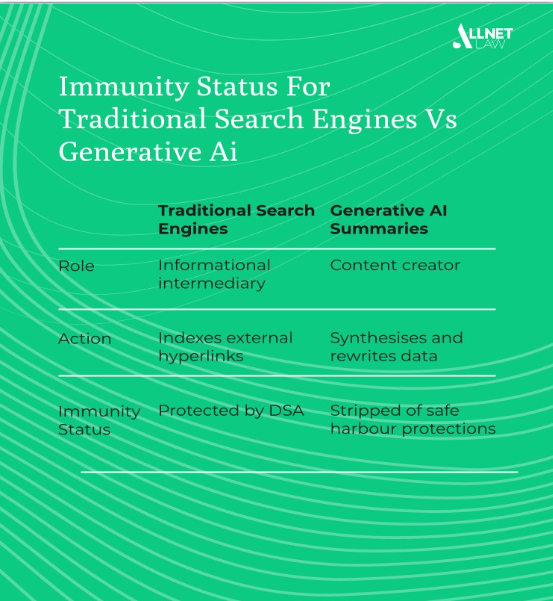
This legal battleground stems from a fundamental shift in how information is delivered: Results from ‘Traditional Search Engines’ Vs ‘Generative AI Summaries’.
Previous case law shielding search engine operators from liability would not apply to AI Overviews in this case, because they generate "independent, new and substantive" statements by evaluating and combining content from multiple third-party websites. Essentially, Google could not claim to be a neutral informational intermediary.


